
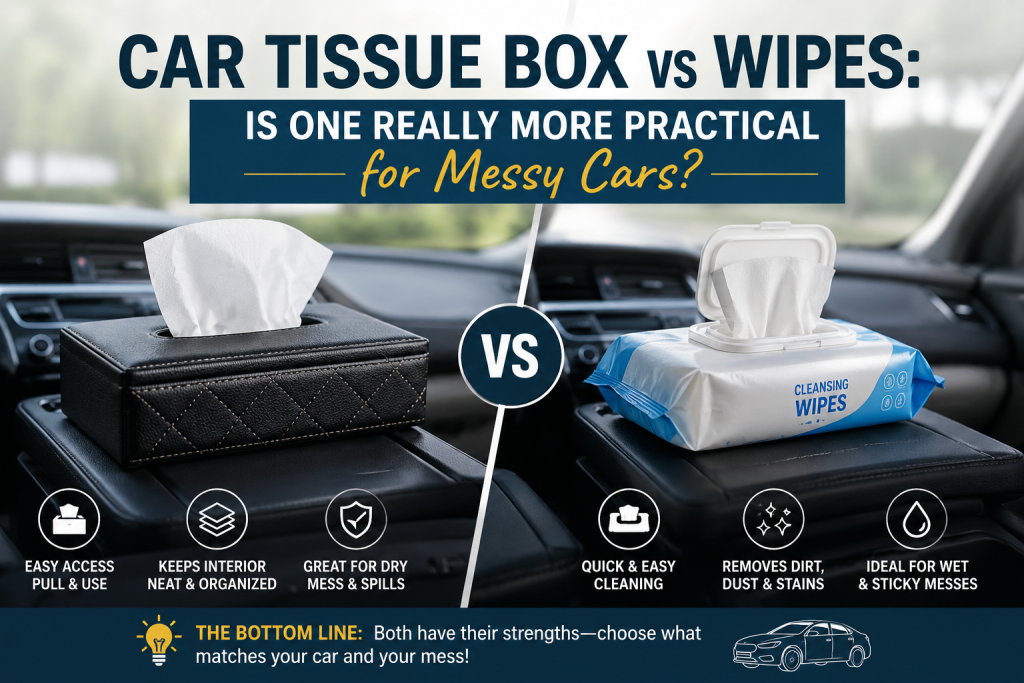
You’ve just had a coffee spill on your passenger seat, your kids have smeared the back windows with sticky fingers, and there’s dust coating your dashboard. You reach out — but which do you grab? The trusty tissue box clipped to your sun visor, or the packet of wet wipes tucked in your glove compartment? If you’ve ever wondered which one earns its space in your car, you’re not alone.
Most UAE drivers keep both — but very few understand exactly when each wins . In this in-depth guide, Ultracare’s hygiene experts break down the real-world performance of car tissue boxes versus wet wipes across every messy scenario you might face on the road.
Understanding What Each Product Is Built For
Before picking a winner, it helps to understand the core purpose behind each product. A car tissue box — like Ultracare’s dedicated car canister tissue — is engineered for quick, one-handed access while you’re on the go. It delivers soft, dry absorbency in a compact, vehicle-friendly format designed to sit neatly in a cup holder or clip onto a sun visor.
Wet wipes , on the other hand, are pre-moistened cloths typically containing water, mild surfactants, and sometimes fragrance or antibacterial agents. They are designed for surface cleaning — wiping down hard surfaces like dashboards, steering wheels, and door panels with actual cleaning power.
Key insight: The fundamental difference isn’t quality — it’s function. Tissues excel at absorbing . Wipes excel at cleaning and disinfecting . Understanding this single distinction solves 80% of the debate.
Most UAE drivers keep both — but very few understand exactly when each wins . In this in-depth guide, Ultracare’s hygiene experts break down the real-world performance of car tissue boxes versus wet wipes across every messy scenario you might face on the road.
The Car Environment: A Special Challenge
Cars are uniquely demanding environments for hygiene products. In the UAE and Gulf region, extreme heat — regularly exceeding 40°C in summer — causes wet wipes to dry out faster and can affect tissue softness. Dust from desert roads makes dashboards magnets for particles. Sticky food residues from on-the-go eating are almost unavoidable. The ideal car hygiene kit needs to address all of these realities.
Head-to-Head Comparison: The Definitive Breakdown
Pros and Cons: Honest Assessment
Car Tissue Box
• Instantly accessible — single-handed pull
• Soft and gentle on face, nose, and eyes
• Stable in extreme heat — no drying out
• Compact canister fits cup holders perfectly
• More cost-effective for daily use
• Biodegradable and eco-friendlier
• No chemical residue on skin or upholstery
• Dry tissue can’t remove sticky or greasy grime
• Leaves lint on screens and glass
• No antibacterial or disinfecting action
• Ineffective on dried or caked-on spills
Wet Wipes
• Lifts grime, grease, and sticky residue
• Antibacterial options kill germs on contact
• Cleans dashboards, screens, and consoles
• Scented options freshen interior surfaces
• One wipe covers a much larger area
• Dry out rapidly in Gulf summer heat
• Chemical ingredients irritate sensitive skin
• Heavier packaging; harder to use one-handed
• More expensive per unit
• Not eco-friendly — contain plastic fibres
• Unsuitable for direct face/nose contact
Real-World Scenarios: What to Reach For
Context is everything. Here’s a breakdown of the most common messy-car moments and which product genuinely handles them better:
You’re on the highway and your nose won’t wait. A soft tissue is the only appropriate option — comfortable, quick, and designed for skin contact.
After drive-through, greasy smudges land on your touchscreen and gear stick. Only a wet wipe will dissolve the oil and actually clean the surface.
Act fast — blot with tissues immediately to absorb as much liquid as possible before it soaks into upholstery. Then follow up with a wipe.
Dry tissue will just move the dust around. A slightly damp wipe traps dust particles and lifts them off the surface cleanly and completely.
For faces and hands — especially children’s — soft tissue is always safer. Wet wipe chemicals can irritate young, sensitive skin.
Antibacterial wet wipes are ideal for cleaning hands when you don’t have access to soap and water — especially after petrol stations or parking.
“The smartest UAE drivers don’t choose between tissues and wipes — they stock both, understand the difference, and never mix up when to use which.”
The Gulf Climate Factor: Heat Changes Everything
If you’re reading this from the UAE, Oman, Qatar, or Kuwait, you already know that a parked car in July can turn into an oven within minutes. This extreme environment significantly affects how hygiene products perform — and it’s a factor that most product comparisons completely ignore.
What Happens to Wet Wipes in 50°C Heat
In a sealed car in summer, interior temperatures can reach 70–80°C . This accelerates the evaporation of moisture inside wipe packets, especially if the resealable flap isn’t perfectly airtight. Within days, you may find your wipes half-dried and less effective. The heat can also cause the preservative chemicals in wipes to break down, potentially leading to bacterial growth within the packet itself.
Gulf driving tip: Store wet wipes in the glove compartment or under the seat — these areas stay 15–20°C cooler than the main cabin in parked cars. Avoid storing them on dashboards or rear window ledges during summer months.
Discover Ultracare's Car Tissue Range
Purpose-built car canister tissues and premium tissue products — crafted in Dubai since 2001 for the UAE’s climate and lifestyle.
Since 2001, Ultracare has been the UAE’s leading manufacturer of hygiene tissue products, supplying to hospitals, airlines, hotels, and households across the Gulf. Our blog content is crafted by hygiene specialists with decades of product experience.